How Sleeping Position Can Influence Pillow Firmness
The best pillow firmness is not determined by personal preference alone. Your sleeping position, shoulder width, mattress feel and pillow height all influence how well your head and neck are supported during the night.
A pillow that feels comfortably soft when you press it with your hand may compress too much under your head. A very firm pillow may hold its shape well but create unwanted pressure if it is too high or does not suit your preferred position. The goal is not to find the hardest or softest option, but a pillow that helps keep your head and neck in a reasonably neutral position while allowing you to relax.
For more practical detail, see our Pillow Firmness and Body Size: What to Consider.
For more practical detail, see our Best Pillow Characteristics for Back Sleepers: A Practical Guide.
For more practical detail, see our How to Choose a Pillowcase for a Contour Pillow.
For more practical detail, see our Signs You Need a New Pillow: How to Tell When Support Is Wearing Out.
This guide explains the relationship between sleeping position and pillow firmness, with practical points for side sleepers, back sleepers and people who change position during the night.
Key takeaways
- Side sleepers commonly need a firmer, higher-support pillow because it must fill the space between the head and the mattress.
- Back sleepers often prefer medium firmness and moderate height, although body shape and mattress softness also matter.
- Stomach sleeping usually calls for a lower, softer pillow to reduce excessive neck rotation or lifting.
- A pillow can feel too firm when it creates pressure or holds the head unnaturally high; it can feel too soft when the head sinks or rolls out of alignment.
- Give a new pillow several nights to assess, but do not ignore persistent neck discomfort or other symptoms.
Table of Contents
- Why sleeping position matters when choosing firmness
- Firmness for side sleepers
- Firmness for back sleepers
- Firmness for stomach sleepers
- What combination sleepers should look for
- Signs your pillow is too soft or too firm
- How your mattress and body shape change the answer
- How to choose and test pillow firmness
- When to seek professional advice
- Frequently asked questions
Why sleeping position matters when choosing firmness
Sleeping position determines the direction in which your head is supported and the amount of space a pillow needs to fill. When you sleep on your side, your shoulder creates a larger gap between your head and the mattress. A pillow with enough structure can fill that gap without collapsing quickly.
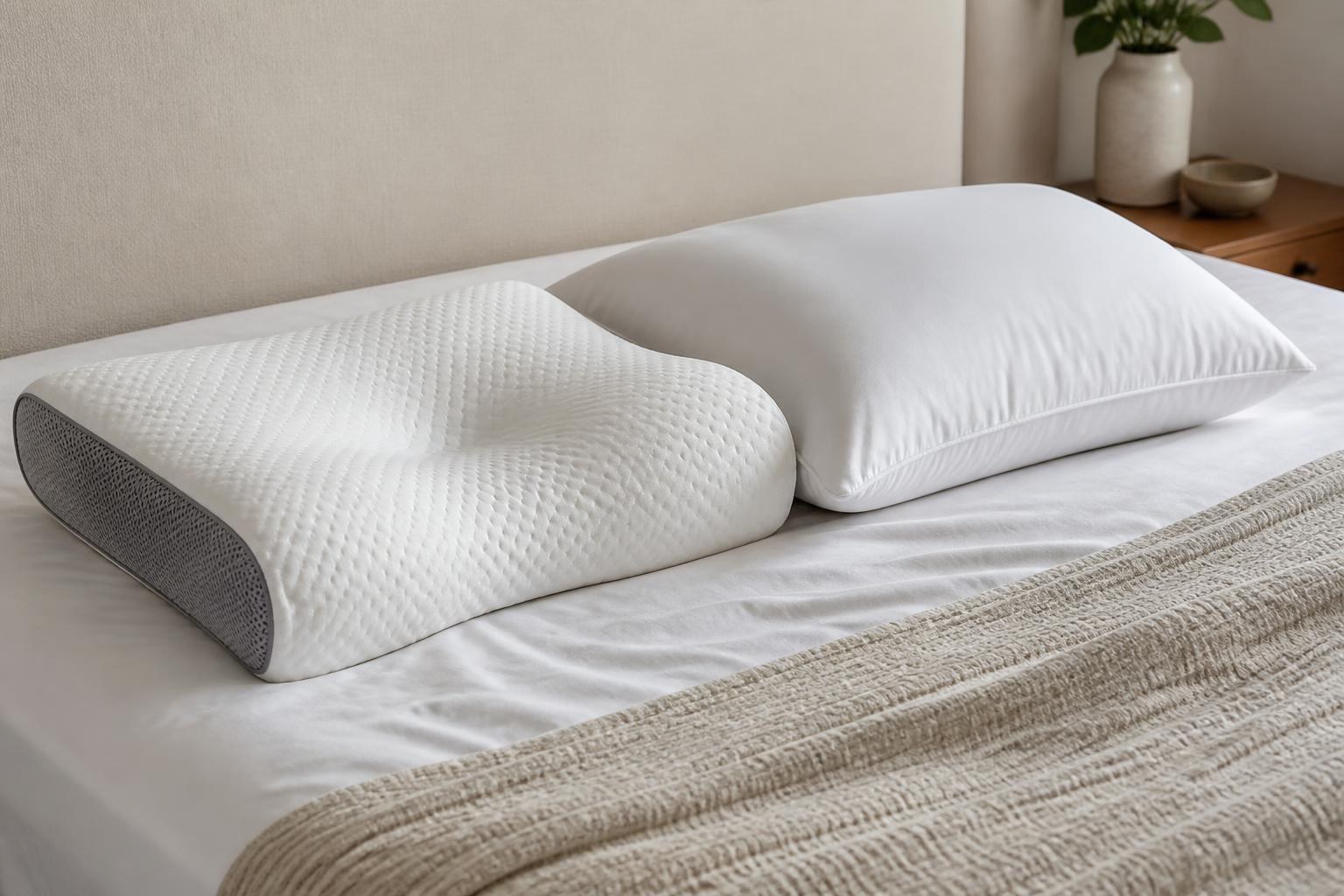
Back sleeping creates a smaller gap, so excessive height can push the head forward. A moderately supportive pillow is often more suitable because it can cradle the head without lifting it too far. Stomach sleeping places different demands on the neck: the head is usually turned to one side, and a thick pillow can increase the angle between the head and the mattress.
Firmness and height are related but not identical. A firm pillow is not automatically high, and a soft pillow is not always low. For example, a low-profile memory foam pillow may feel relatively firm, while a tall fibre pillow may compress substantially under load. Consider how the pillow behaves after you lie down rather than judging it only by touch.
Firmness for side sleepers
Side sleepers often benefit from a medium-firm to firm pillow with enough height to support the head between the mattress and shoulder. The best choice depends on shoulder width, mattress firmness and the extent to which the pillow compresses.
A very soft pillow may flatten during the night, leaving the head angled down toward the mattress. This can make the pillow feel comfortable at first but less supportive after several hours. A firm, shaped pillow may provide more consistent support, provided its contour and height match the sleeper’s body.
What to check in a side-sleeping position
- Your nose should point roughly forward rather than noticeably toward the mattress or ceiling.
- Your head should feel supported without pressure building under the ear or jaw.
- The pillow should fill the space above the shoulder without forcing the shoulder forward.
- The shoulder should remain on the mattress, not be pushed upward by an excessively tall pillow.
People with broader shoulders may need more loft or a more resilient filling. A softer mattress can also reduce the gap because the shoulder sinks into it. That means a pillow that works on a firm mattress may feel too high on a plush one.
Firmness for back sleepers
Back sleepers commonly need a pillow with moderate height and enough firmness to prevent the head from sinking too far. A pillow that is too soft may allow the head to fall backward, while one that is too firm or tall can push the chin toward the chest.
Look for a pillow that supports the natural curve of the neck without creating a pronounced bend. Contoured or ergonomic designs may be useful for some back sleepers because different sections can support the head and neck at different heights. However, the shape still needs to suit your body and mattress.
For reliable supporting context on this point, see Sleeping positions that reduce back pain.
A pillow that feels supportive while lying down may become less comfortable if it encourages the head to remain tilted. Try to assess the position from the side, using a mirror or a quick photograph taken by someone else. The aim is not perfect medical alignment, but a relaxed, neutral-feeling posture without obvious lifting or dropping of the head.
Firmness for stomach sleepers
Stomach sleeping generally works better with a low, relatively soft pillow, or sometimes no pillow under the head. A thick or very firm pillow can raise the head while it is turned to the side, potentially making the position feel strained.
Some people who identify as stomach sleepers actually spend part of the night in a semi-stomach or three-quarter position. In that case, a low-profile pillow with some resilience may offer a useful compromise. It should compress enough to avoid excessive height but still provide a small amount of cushioning.
To check current price, availability and purchase terms, see the Derila Ergo offer.
There is no need to force yourself into a different position solely because a particular pillow recommendation says it is ideal. Comfort, natural movement and the ability to relax matter. If stomach sleeping consistently leaves you with neck discomfort, experimenting with a lower pillow and a slightly different position may be worthwhile.
For more practical detail, see our Persistent Neck Discomfort: When to Speak With a Professional.
What combination sleepers should look for
Combination sleepers change position during the night, so a pillow that performs well in only one position may become inconvenient. A medium or adjustable firmness can be a practical starting point, particularly when the pillow can be reshaped or used with removable layers.
Consider the position in which you spend the most time, then look for enough flexibility for your secondary position. For example, someone who moves mainly between the side and back may prefer a supportive pillow with a moderate profile rather than an extremely high side-sleeper pillow.
Responsiveness also matters. A pillow that quickly regains its shape can make repositioning easier, while a very dense material may feel slow to adjust. On the other hand, excessive softness can make the head move too freely. The right balance depends on whether you value a stable, held-in feeling or a softer, less structured surface.
Signs your pillow is too soft or too firm
Firmness is personal, but certain patterns can reveal a mismatch. Assess the pillow over several nights rather than relying on the first few minutes, especially if it is made from a material that changes feel with temperature.
Possible signs that a pillow is too soft
- Your head sinks until the pillow feels nearly flat.
- You wake up and find your head has moved off the main support area.
- You regularly fold or double the pillow to create more height.
- The pillow loses its shape during the night and needs frequent rearranging.
Possible signs that a pillow is too firm or too high
- Your head feels pushed upward or forward.
- You notice pressure around the ear, temple or side of the face.
- Your neck feels held in one position rather than comfortably supported.
- You sleep better when part of the pillow is removed or compressed.
These signs can also result from incorrect height, a worn-out pillow or a mattress that does not suit your sleeping position. Firmness should therefore be assessed together with shape, loft and material behaviour.
How your mattress and body shape change the answer
A pillow never works in isolation. A firm mattress usually leaves the shoulder higher, increasing the space the pillow needs to fill for side sleeping. A softer mattress allows the shoulder and upper body to sink, often reducing the required pillow height.
Body proportions matter as well. Shoulder width, neck length and head size can all affect how a particular pillow feels. Two people who sleep in the same position may need different firmness levels because their bodies interact with the mattress differently.

Consider your usual sleep surface when comparing pillows. If you frequently sleep in different beds, such as at home and while travelling, a highly adjustable design may be easier to adapt. A pillow that is slightly too high can sometimes be made more comfortable by changing the mattress position or removing an insert, but major mismatches are harder to correct.
For reliable supporting context on this point, see Neck pain and stiff neck.
How to choose and test pillow firmness
Start with your main sleeping position, then consider the following checklist:
- Measure the gap. Lie in your usual position and consider how much space exists between your head and the mattress.
- Check compression. Ask how much the pillow will flatten under your head, rather than judging its firmness by pressing it with one hand.
- Look for stable support. The pillow should keep its shape long enough to support you between position changes.
- Consider adjustability. Removable layers, flexible filling or a shaped design can make fine-tuning easier.
- Review the return terms. A settling-in period is useful, but an appropriate trial or return policy reduces the risk of choosing a poor match.
When testing a new pillow, use your normal mattress and sleep position. Try it for several nights if it feels unfamiliar, since a different shape can require an adjustment period. Avoid changing the pillow, mattress and sleeping position at the same time, because it becomes difficult to identify what helped or caused discomfort.
When to seek professional advice
A pillow can influence comfort and sleeping posture, but it is not a treatment for a medical condition. If you experience persistent neck pain, numbness, weakness, severe stiffness or symptoms that interfere with daily activities, seek advice from an appropriate healthcare professional. The NHS advises people with concerning or ongoing neck symptoms to obtain medical guidance rather than relying only on self-care.
People managing an existing musculoskeletal condition, recovering from an injury or experiencing recurring symptoms may also benefit from personalised advice. A healthcare professional can help distinguish a pillow-related comfort issue from a problem requiring further assessment. Mayo Clinic guidance on sleeping positions similarly focuses on reducing strain through positioning rather than promising that a particular pillow will resolve back pain.
Frequently asked questions
Is a firm pillow always better for side sleepers?
No. Side sleepers often need more structure and height, but an excessively firm or tall pillow can create pressure and push the head out of a comfortable position. The best option provides stable support while matching your shoulder width and mattress.
What firmness is usually suitable for back sleeping?
Many back sleepers prefer medium firmness with moderate height. The pillow should support the head and neck without pushing the head forward or allowing it to sink too far backward. Individual body shape and mattress feel can change the ideal choice.
Can a soft pillow support the neck properly?
Yes, if it retains enough shape and has the right height. A soft pillow becomes less suitable when it compresses completely, shifts away from the head or leaves the neck unsupported during the night.
How long should I try a new pillow before deciding?
Give yourself several nights to adapt, using your normal bed and sleeping position. If the pillow repeatedly creates pressure, forces your head into an awkward angle or worsens discomfort, it may not be the right firmness or height for you.
Should stomach sleepers use a firm pillow?
Usually, a low and softer pillow is more comfortable for stomach sleeping because it avoids lifting the head too far while it is turned to the side. Some stomach sleepers prefer no pillow under the head, while others need a small amount of cushioning.