Best Pillow Characteristics for Back Sleepers: A Practical Guide
Back sleeping can provide a balanced position for the head, neck, shoulders and spine, but the pillow still needs to do its job well. A pillow that is too high can push the head forward. One that is too flat may allow the head to tilt backwards. Either situation can leave you waking with stiffness or feeling that your neck has not been properly supported.
The best pillow characteristics for back sleepers are usually moderate height, stable support, comfortable pressure distribution and a shape that helps keep the head and neck in a neutral position. The ideal choice also depends on your body shape, mattress firmness, shoulder width and whether you change positions during the night.
For more practical detail, see our Pillow Firmness and Body Size: What to Consider.
For more practical detail, see our How to Choose a Pillowcase for a Contour Pillow.
For more practical detail, see our Signs You Need a New Pillow: How to Tell When Support Is Wearing Out.
For more practical detail, see our How Sleeping Position Can Influence Pillow Firmness.
This guide explains what to look for without treating any pillow as a medical device or promising pain relief. If you have persistent neck discomfort, numbness, weakness or other concerning symptoms, speak with an appropriate healthcare professional.
For more practical detail, see our Persistent Neck Discomfort: When to Speak With a Professional.
Key Takeaways
- Back sleepers often need a pillow with low-to-medium height rather than a very tall, overfilled design.
- The pillow should support the natural curve of the neck without forcing the chin towards the chest.
- Medium or medium-firm support may offer a useful balance between cushioning and stability, but personal comfort matters.
- Your mattress changes how much pillow height you need: a softer mattress may require a slightly lower pillow because the shoulders sink further into the surface.
- A small cushion under the knees can sometimes make back sleeping feel more comfortable by reducing strain through the lower back.
Table of Contents
- Start with neutral head and neck alignment
- Choose the right pillow height
- Consider shape and contour
- Look for suitable firmness and materials
- Match the pillow to your mattress and body
- How to check your position at home
- Common mistakes back sleepers make
- When to replace or reconsider your pillow
- Frequently asked questions
Start with neutral head and neck alignment
The main purpose of a back-sleeping pillow is to fill the space between the back of your head and the mattress while supporting the neck’s natural curve. Your head should feel supported without being tipped noticeably forward, backward or to one side.
Imagine looking straight upwards while lying down. Your chin should not be pressed towards your chest, and your face should not point markedly towards the ceiling because the pillow is too low. The neck should feel relaxed rather than stretched. Your shoulders should remain on the mattress instead of being pushed upwards by an overly broad or tall pillow.
There is no single alignment measurement that suits every sleeper. A person with a smaller frame may need less loft than someone with a broader upper body. The goal is not to create a rigid posture, but to avoid obvious bending or twisting while you rest.
Guidance from the Mayo Clinic on sleeping positions also highlights the value of supporting the natural curves of the body and using additional positioning support when helpful. This is a comfort and posture principle, not a guarantee that a particular pillow will resolve back or neck symptoms.
Choose the right pillow height
Height, often called loft, is one of the most important characteristics for back sleepers. A medium-low or medium loft is a useful starting point because back sleeping generally requires less space-filling than side sleeping. However, the correct height depends on your anatomy and mattress.
Signs the pillow may be too high
- Your chin is pushed towards your chest.
- You feel tension at the front or sides of the neck.
- Your head seems to sit noticeably higher than your shoulders.
- You need to pull the pillow down during the night to feel comfortable.
Signs the pillow may be too low
- Your head tilts backwards or feels unsupported.
- You notice a gap beneath the neck that the pillow is not filling.
- You instinctively place an arm or folded towel beneath the pillow.
- You wake with a feeling that your neck has been extended for several hours.
Adjustable-fill pillows can make fine-tuning easier because you can remove or add material. A shaped pillow with different-height areas may also provide options, although its contours need to suit your body rather than simply look ergonomic.
For reliable supporting context on this point, see Sleeping positions that reduce back pain.
Consider shape and contour
A traditional rectangular pillow can work well for back sleeping when its height and fill are appropriate. Its advantage is simplicity: you can move it slightly higher or lower and use the whole surface for your head and neck.
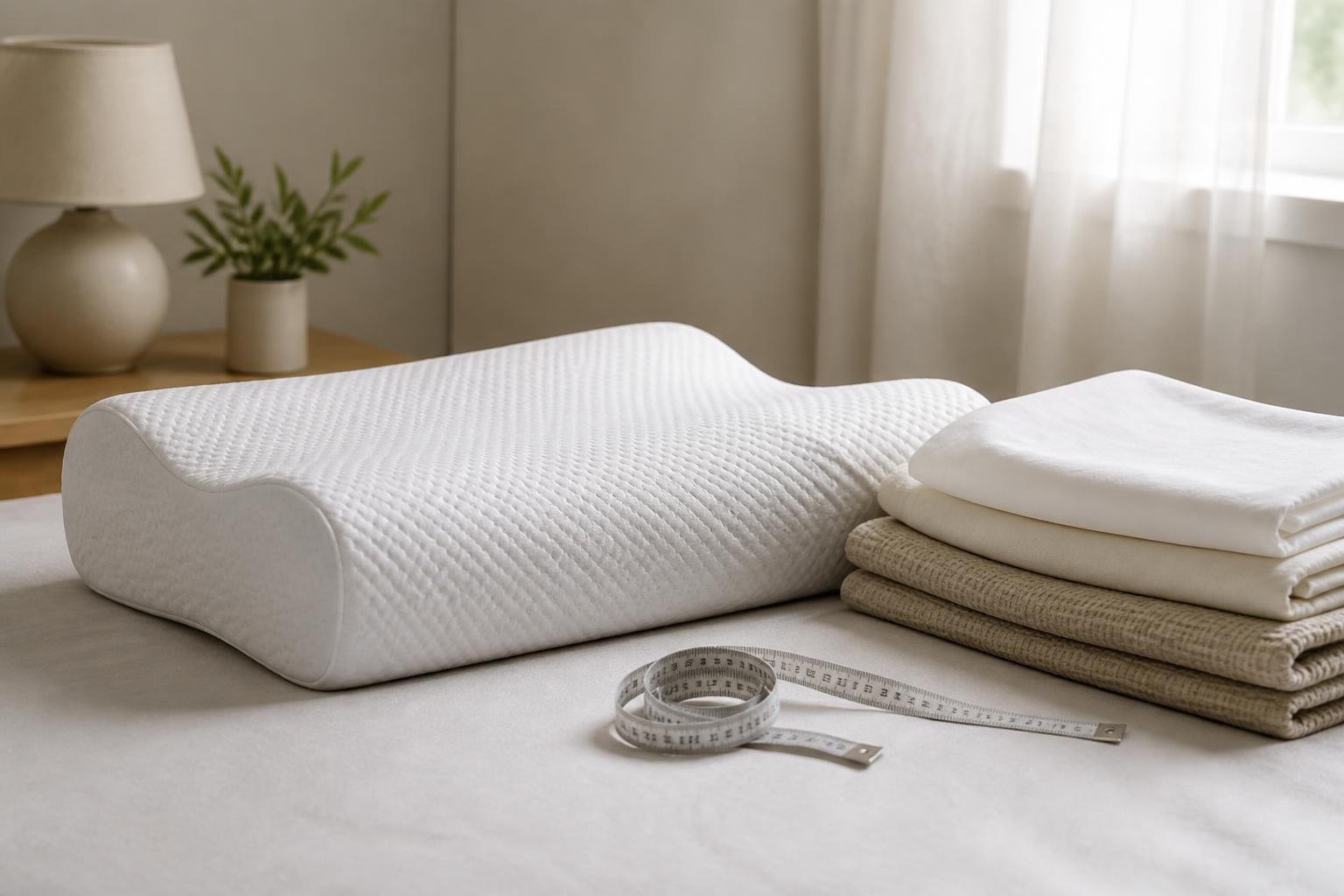
Contour pillows have a raised section intended to support the neck and a lower section for the head. When the dimensions suit you, this design may help maintain a more consistent position than a pillow that compresses unevenly. Some back sleepers prefer the lower contour, while others need the higher edge. Checking both options can be worthwhile.
Be cautious with very deep contours or pronounced shapes. A design that feels supportive in a few minutes may become uncomfortable if it holds your head at an angle for hours. The pillow should not force you into one exact position if you naturally make small movements while sleeping.
Shape also affects shoulder freedom. A pillow that is too wide, rigid or heavily raised at the sides may press against the shoulders or encourage them to lift. Back sleepers usually benefit from a central support area that cushions the head while allowing the shoulders to remain relaxed.
Look for suitable firmness and materials
Firmness and height are related, but they are not the same. A soft pillow may have a high initial loft but compress significantly under the head. A firm pillow may maintain its shape while feeling too unyielding. The best choice provides enough resistance to support the head without creating pressure points.
| Feature | What it may offer back sleepers | What to watch for |
|---|---|---|
| Medium support | A balance of cushioning and shape retention | It may still feel too firm for people who prefer a plush surface |
| Memory foam | Stable support and reduced tendency to flatten quickly | Some foams retain heat or feel less responsive when changing position |
| Latex or resilient foam | Buoyant support and easier movement | The springier feel may not suit people who prefer deep cushioning |
| Fibre or down-like fill | Soft, adjustable, familiar comfort | It may require regular refluffing and can lose height over time |
Material choice should support your comfort preferences, sleeping temperature and maintenance needs. Breathability can matter if you tend to feel warm at night. A removable, washable cover is also practical, although the inner pillow may have different care requirements.
A pillow does not need to feel hard to be supportive. Support means maintaining a suitable position under load, not simply having a rigid surface. If you feel pressure at the back of your head or cannot relax your jaw and shoulders, the pillow may be too firm, too high or both.
Match the pillow to your mattress and body
Your pillow cannot be selected in isolation from your bed. On a softer mattress, your shoulders and upper back may sink further into the surface. This can reduce the gap between your head and the mattress, making a lower pillow more suitable. On a firm mattress, your upper body may remain higher, so you might need slightly more loft.
Body proportions matter too. A person with a narrow frame may be comfortable on a relatively low pillow, while someone with broader shoulders may need additional support even when sleeping on their back. Neck length, head size and the natural curve of the upper spine also influence the fit.
If you share a bed, do not assume that the same pillow will suit both people. Matching your pillow to your own body and mattress side is more useful than choosing a universal height.
Some back sleepers place a small cushion beneath their knees. This can feel comfortable because it changes the position of the hips and may reduce the sensation of tension in the lower back. It is an optional positioning aid, not a treatment for back pain. Stop using it if it creates discomfort or numbness.
How to check your position at home
You can perform a simple comfort check before committing to a new pillow. Lie on your back in your usual sleeping position and allow your shoulders to settle naturally. Avoid lifting your chin or deliberately holding your head still.
For more practical detail, see our Derila Ergo Discounts and Offers: What to Verify Before Buying.
To check current price, availability and purchase terms, see the Derila Ergo offer.
For reliable supporting context on this point, see Say “good night” to neck pain.
- Check your face: it should point generally upwards rather than noticeably towards your chest or the wall behind you.
- Check your chin: it should feel relaxed, not compressed towards the sternum.
- Check your shoulders: they should rest on the mattress instead of being pushed up by the pillow.
- Check the neck: you should feel supported through the curve without a sharp pressure point.
- Check movement: you should be able to turn your head slightly without feeling trapped by the pillow.
A side-view photograph can make obvious bending easier to spot, but do not treat a single image as a medical assessment. Comfort over several nights is also relevant. A pillow may feel unfamiliar at first, particularly if its shape differs from your old one, so evaluate it after allowing reasonable time to adjust while following the seller’s return and care terms.
Common mistakes back sleepers make
- Choosing the tallest pillow: More loft does not automatically mean more support. Excess height can move the head forward.
- Testing only while sitting: A pillow that feels comfortable against a headboard may behave differently when your full body is lying flat.
- Ignoring the mattress: Pillow height that worked on a firm bed may be excessive on a softer one.
- Using several loose pillows: Stacking pillows can create unstable angles and make alignment inconsistent.
- Focusing only on softness: A plush surface can feel pleasant initially but may not provide enough stable support.
- Expecting a pillow to solve persistent symptoms: Ongoing discomfort deserves professional advice rather than repeated pillow purchases.
Harvard Health notes that keeping the head and neck in a neutral position can be relevant when trying to reduce strain during sleep. If discomfort continues despite sensible adjustments, seek advice from a qualified healthcare professional rather than forcing yourself to remain in a position that feels wrong.
When to replace or reconsider your pillow
Even a well-chosen pillow can become less suitable with use. Flattened areas, permanent lumps, a cover that no longer fits properly or a noticeable loss of support are practical reasons to reassess it. Changes in your mattress, body, sleeping position or comfort needs can also affect the fit.
Pay attention to how you feel when you wake, but avoid assuming that every morning ache is caused by your pillow. A pillow may contribute to poor positioning, yet sleep duration, stress, activity, the mattress and other factors can also influence comfort.
Replace a pillow according to its condition and the manufacturer’s care guidance rather than relying only on a fixed timetable. Wash or air it only as instructed, since moisture and unsuitable cleaning can damage some foams and fillings.
Frequently asked questions
What is the best pillow height for a back sleeper?
A low-to-medium height is a sensible starting point for many back sleepers, but the correct loft depends on your body proportions, mattress firmness and pillow compression. Your head should remain level and your neck comfortably supported.
Should back sleepers use a contour pillow?
They can, provided the contour dimensions suit your neck and head. A contour pillow may help maintain a consistent position, but a pronounced shape can feel too high or restrictive for some people.
Is a firm pillow better for back sleeping?
Not necessarily. A medium or moderately supportive pillow may provide a better balance between stability and cushioning. The right firmness is the one that supports your head without creating pressure or forcing your neck into an angle.
Should I put a pillow under my knees when sleeping on my back?
A small cushion under the knees may feel comfortable for some people and can change the position of the lower body. It is optional and should not create pain, numbness or pressure.
When should I ask a professional about neck discomfort?
Seek professional guidance for persistent or worsening discomfort, pain after an injury, numbness, weakness, tingling or symptoms that interfere with daily activities. Pillow adjustments should not replace appropriate assessment.